



Gistly
Subscribe to newsletter
Thank you! Your submission has been received!
Oops! Something went wrong while submitting the form.


Conversation intelligence is a technology that uses artificial intelligence to capture, transcribe, and analyze spoken interactions between businesses and their customers. Rather than relying on manual note-taking or selective call reviews, conversation intelligence platforms automatically process every call, meeting, or customer interaction — turning hours of unstructured audio into searchable, analyzable data.
In this article
At its core, conversation intelligence answers a question that organizations have struggled with for decades: What is actually being said in the thousands of conversations happening across your business every day?
Before AI-powered conversation intelligence, the answer was largely unknowable. Research from McKinsey found that without automation, teams could realistically review only about 3% of their customer conversations. The other 97% went unmonitored — full of potential insights about customer needs, compliance risks, coaching opportunities, and competitive threats that simply went unseen.
Modern conversation intelligence changes that equation entirely. Platforms can now review and analyze close to 100% of interactions, surfacing patterns and insights at a scale that was previously impossible.
Conversation intelligence platforms operate through a multi-layered analysis pipeline. While the specific implementations differ between vendors, the general workflow follows a consistent pattern.
The platform records or ingests audio from customer interactions. This can happen through native integrations with calling platforms (Zoom, Microsoft Teams, Google Meet, dialers), direct audio uploads, or API connections with telephony systems. Some platforms also support video capture and screen recording.
Advanced speech-to-text engines convert the audio into text transcripts. Modern platforms use large language models that achieve near-human accuracy, including speaker diarization (identifying who said what), handling of accents and dialects, and support for multiple languages. The best platforms support 70 to over 100 languages with high fidelity.
This is where the AI adds the most value. The platform applies multiple analytical layers to the transcript:
The analyzed data is presented through dashboards, reports, alerts, and summaries. Teams can view trends over time, drill into individual conversations, receive automatic alerts when certain conditions are met (such as a compliance violation), and track performance metrics across agents, teams, or time periods.
Insights connect back to the systems teams already use — CRMs, helpdesks, project management tools, and workflow automation platforms — so that conversation data feeds directly into existing business processes rather than living in a silo.
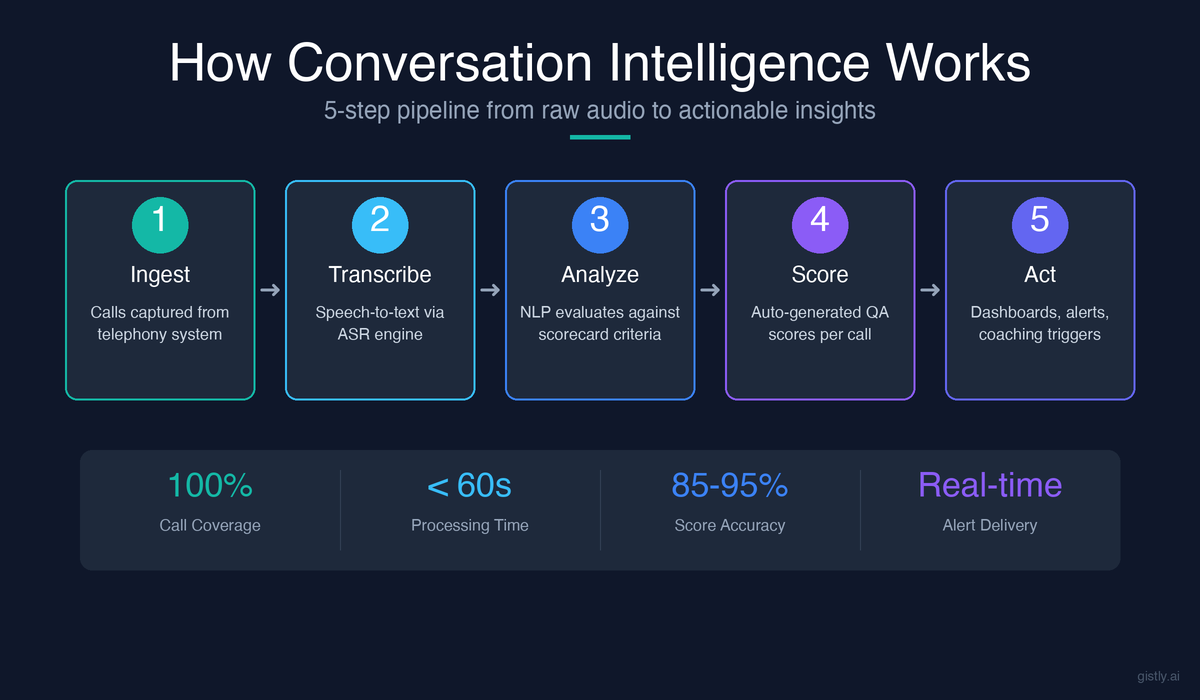
The 5-step conversation intelligence pipeline: from raw audio to actionable quality insights.
These three technologies are often confused. Here is how they compare across key capabilities:
| Capability | Call Recording | Speech Analytics | Conversation Intelligence |
|---|---|---|---|
| Captures audio | Yes | Yes | Yes |
| Transcription | No (manual) | Yes | Yes |
| Keyword detection | No | Yes | Yes |
| Sentiment analysis | No | Basic | Advanced |
| Agent scoring | No | Limited | Full QA scorecards |
| Coaching insights | No | Trend-level | Call-level + agent-level |
| Compliance monitoring | Retroactive only | Keyword-based | Context-aware |
| Real-time alerts | No | Some platforms | Yes |
Want to see these 5 steps in action?
Gistly delivers a findings report within 48 hours of receiving your call data.
Book a Demo →Not every platform offers the same capabilities. Here are the features that define the modern conversation intelligence category:
Automatic, accurate conversion of speech to text across multiple languages. Look for platforms that support 100+ languages if you serve global or multilingual markets.
The ability to define quality criteria specific to your business, then have the AI score every conversation against those standards. The most useful platforms let you build custom templates rather than forcing you into a one-size-fits-all scoring model.
Automated detection of compliance deviations — missed disclosures, prohibited claims, regulatory violations. This is essential for industries like financial services, healthcare, insurance, and collections, where a single compliance failure can carry significant legal and financial consequences.
Understanding not just what was said but how it was said. Sentiment analysis helps teams catch customer dissatisfaction early, identify moments of high engagement, and coach agents on emotional intelligence.
AI-generated summaries that distill a 30-minute conversation into key points, decisions, and next steps. This saves hours of manual review and ensures that follow-up items don't slip through the cracks.
Scorecards, benchmarks, and trend data that help managers provide targeted coaching. The best platforms identify specific coaching opportunities — not just that an agent underperformed, but exactly where in the conversation the opportunity was missed and what a better approach would look like.
A centralized, searchable repository of all analyzed conversations. Teams can search by keyword, topic, sentiment, agent, date, or custom tags to find specific moments across thousands of interactions.
Some platforms allow users to ask natural-language questions against a call transcript — for example, "Did the agent mention the 30-day return policy?" — and receive direct answers. This is especially valuable for QA auditors reviewing flagged conversations.
Seamless data flow between the conversation intelligence platform and the tools teams use daily, from Salesforce and HubSpot to Zendesk and Slack.
Conversation intelligence started in sales but has expanded well beyond it. Here are the primary use cases by department:
Sales was the original home for conversation intelligence, and it remains a major use case. Sales teams use CI to understand which talk tracks lead to closed deals, identify coaching opportunities for underperforming reps, track competitor mentions and objections, and gain visibility into deal health based on actual conversation signals rather than self-reported CRM data.
Research indicates that companies using conversation intelligence see improvements across key sales metrics: better understanding of competition, improved visibility into rep activity, and deeper understanding of customer needs.
Support teams use conversation intelligence to monitor service quality at scale, reduce escalations by identifying problematic interaction patterns, ensure agents follow resolution protocols, track customer satisfaction signals across every interaction (not just post-call surveys), and identify training opportunities based on real interaction data.
For support organizations, the shift from reviewing a handful of calls per agent per month to monitoring 100% of interactions fundamentally changes quality management.
Collections is one of the most compliance-sensitive areas of business communication. Conversation intelligence helps collections teams audit every call for regulatory compliance (FDCPA, TCPA, state regulations), verify that mandated disclosures are made, flag prohibited claims or language, reduce legal exposure through proactive monitoring, and coach agents on compliant communication techniques.
Beyond collections, compliance teams across regulated industries use conversation intelligence to maintain audit trails, demonstrate regulatory adherence, identify systemic compliance gaps before they become enforcement actions, and support internal investigations with searchable, time-stamped interaction records.
Enablement professionals use conversation intelligence to build libraries of best-practice call examples, create data-driven training programs based on what actually works (not assumptions), onboard new hires faster by giving them access to real call recordings annotated with AI insights, and measure the impact of training initiatives on actual conversation performance.
See how Gistly audits 100% of conversations in 48 hours
No complex setup. No months of onboarding. Just results.
Book a Demo →Moving from 3% to near-100% conversation coverage means that insights are based on representative data, not a biased sample of manually selected calls.
Automated transcription, summarization, and scoring eliminate hours of manual work per agent per week. Teams report up to 90% reduction in time spent on manual QA tasks.
Organizations using conversation intelligence report measurably better sales performance, higher customer satisfaction scores, and reduced churn — driven by better coaching, faster issue identification, and more consistent interaction quality.
For regulated industries, the ability to automatically flag compliance issues across 100% of interactions dramatically reduces the risk of enforcement actions, fines, and litigation.
Conversation data provides a ground-truth layer that complements traditional metrics like CRM data, survey results, and operational dashboards. When you know what's actually being said in customer conversations, you make better strategic decisions.
New team members ramp faster when they have access to searchable libraries of real conversations, annotated with AI insights about what works and what doesn't.
Ready to unlock these benefits for your team?
Join teams that moved from 3% sampling to 100% coverage with Gistly.
See How It Works →With over 120 platforms in the market as of 2026, selecting the right one requires clarity about your specific needs. Here are the key evaluation criteria:
Are you buying for sales coaching? QA and compliance? Support quality monitoring? Multi-department analytics? The "best" platform depends entirely on what problem you're solving. Some platforms are built specifically for sales revenue intelligence, while others are designed for quality assurance and compliance monitoring. Choosing a tool that matches your primary use case will yield far better results than forcing a sales-centric platform into a compliance role, or vice versa.
If you operate globally or serve multilingual customers, transcription accuracy across languages is critical. Some platforms support 70+ languages, while others exceed 100. Test accuracy in your specific languages before committing.
Can you build custom QA scorecards and templates? Can you define your own compliance rules? A platform that forces you into pre-built frameworks may not adapt well to your industry's specific requirements.
Pricing in conversation intelligence varies dramatically. Some platforms charge transparent, per-user rates. Others layer platform fees, add-on module charges, implementation costs, and annual minimums that can double or triple the apparent per-user price. Always calculate the full annual cost for your team size, including all modules you'll need.
How well does the platform connect with your existing tech stack? Look beyond basic integrations — evaluate whether conversation data flows bidirectionally with your CRM, helpdesk, and workflow tools.
The fastest time-to-value comes from platforms that are quick to deploy and intuitive to use. Heavy implementation requirements and steep learning curves reduce adoption and delay ROI.
For regulated industries, verify SOC 2 Type II compliance, GDPR readiness, data encryption standards, and any industry-specific certifications (HIPAA, PCI-DSS) that your organization requires.
The conversation intelligence market has matured significantly. What was once a niche category focused on call recording and basic analytics has evolved into a core component of the modern business technology stack.
Several trends define the current landscape. Real-time capabilities are becoming standard — platforms increasingly provide insights during conversations, not just after them. The category is expanding beyond sales into support, collections, compliance, and other departments that rely on spoken communication. AI capabilities have deepened, moving from simple keyword spotting to genuine contextual understanding of conversations. And pricing models are diversifying, with more platforms offering transparent, accessible pricing alongside the traditional enterprise quote-based approach.
Gartner estimates that conversation intelligence integration in contact centers could reduce agent labor costs by $80 billion by 2026, signaling just how central this technology has become to business operations.
If you're evaluating conversation intelligence for your organization, start with these steps:
Identify your highest-value use case. Where are the biggest gaps in your current conversation visibility? Sales coaching? QA coverage? Compliance monitoring?
Calculate your current cost of not knowing. How many conversations go unreviewed? What's the risk exposure from unmonitored compliance? How much time does your team spend on manual call reviews?
Run a focused pilot. Test your shortlisted platform on a single team or use case before committing to a broader rollout. Measure against specific KPIs you defined before the pilot started.
Plan for adoption, not just deployment. The best platform delivers zero value if your team doesn't use it. Prioritize ease of use, intuitive dashboards, and actionable (not overwhelming) insights.
Conversation intelligence is no longer an emerging technology — it's a mature, proven category that delivers measurable results across sales, support, collections, and compliance. The question isn't whether to adopt it, but which platform best fits your specific needs.
Conversation intelligence is a technology that uses AI to capture, transcribe, and analyze spoken interactions between agents and customers. It goes beyond basic call recording by automatically scoring quality, detecting compliance issues, identifying coaching opportunities, and surfacing trends across thousands of conversations.
Call recording captures audio. Conversation intelligence analyzes it. A recording platform stores calls for later review. A conversation intelligence platform transcribes every call, applies QA scorecards, flags compliance risks, detects sentiment patterns, and delivers actionable insights without anyone needing to listen to the recording manually.
Speech analytics focuses on extracting data from audio: keywords, phrases, sentiment scores, and talk patterns. Conversation intelligence is a broader category that includes speech analytics plus QA scoring, compliance monitoring, agent coaching workflows, and cross-departmental analytics. For a detailed breakdown, see our guide on conversation intelligence vs speech analytics.
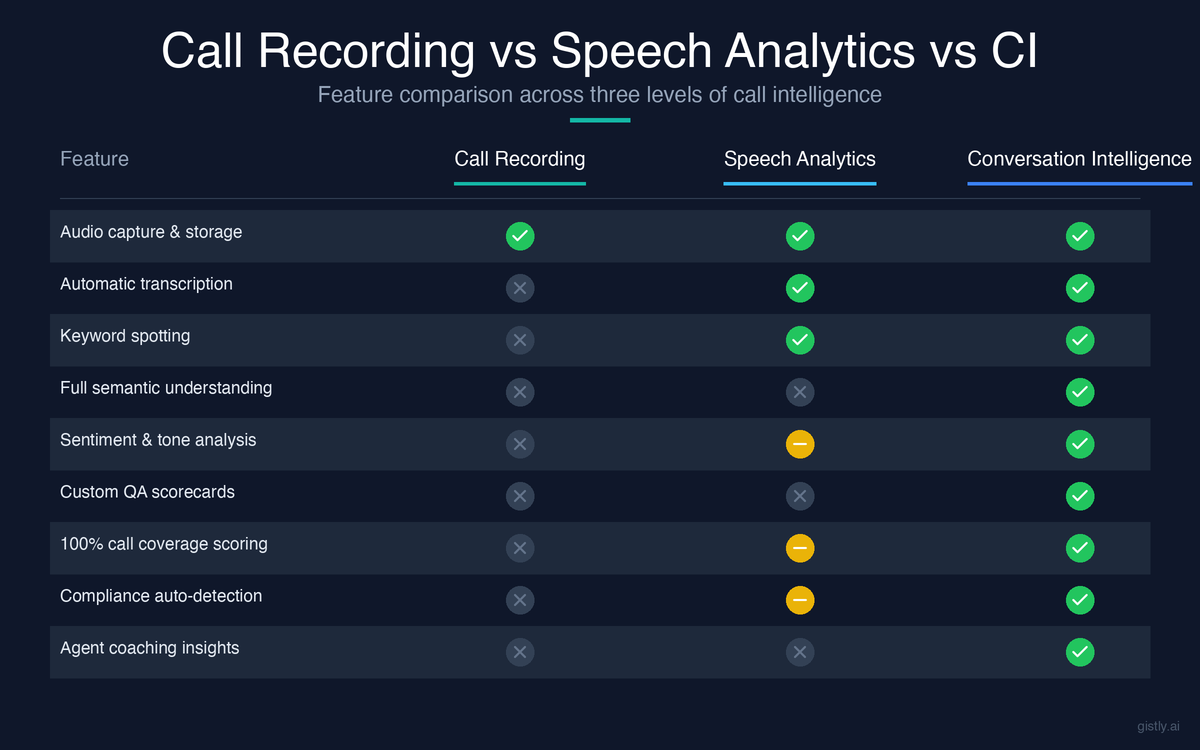
Call Recording vs Speech Analytics vs Conversation Intelligence: a feature-by-feature comparison.
Sales, customer support, collections, compliance, and training teams all use conversation intelligence for different purposes. Sales teams use it for coaching and deal intelligence. Support teams track resolution quality and CSAT drivers. Collections teams monitor regulatory compliance. Training teams identify skill gaps across the organization.
Deployment timelines vary significantly. Enterprise platforms may take weeks or months for full integration. Cloud-native platforms like Gistly can deliver a findings report within 48 hours of receiving call data, with full deployment in days rather than months.
Modern AI transcription achieves 85-95% accuracy depending on audio quality, accent, and language. For compliance monitoring, the best platforms combine automated detection with human-in-the-loop review for flagged items. This approach catches significantly more violations than manual sampling, which covers only 2-5% of calls.
Prioritize accuracy of transcription (especially if you handle multilingual conversations), customizable QA scorecards, compliance monitoring capabilities, and integration with your existing tools. Also evaluate deployment speed, pricing transparency, and whether the platform supports your specific use case, whether that is sales coaching, QA auditing, or compliance monitoring. A platform that forces a one-size-fits-all approach will create more work than it saves.
Gistly is an AI conversation intelligence platform built for QA, compliance, and call analytics across sales, support, and collections teams. See how it works →
Related reading:
Last updated: March 2026
Gistly audits every conversation automatically — compliance flags, QA scores, and coaching insights in 48 hours.